It’s ten minutes past close when I blink and find that I’m still lost in my own palm. My left hand lays motionless before me, a corpse at a viewing. The singular spotlight that normally shines over the circular table in the middle of the room is off, and all that remains to illuminate my reading is the pulsating hum of green neon from the sign in the window. The words flash one at a time, all together, and then disappear. “Palm Readings… Mystic Dabrowski.” The words surround an out turned hand. I take my mother’s reading needle, and trace it over the mounts and lines. “Divination is half reading, half guiding the seeker, but all pageantry” my mother used to say. The needle hisses as it scrapes across the soft flesh of my hand. Health, Love, Heart, Head. All lines interweave like the threads of a dreamcatcher. And here, in the gloom, I can’t interpret any of it.
The last woman to come in was too young to be as dead as she was. Upon her face was the same desperate mask they all wear when walking through my door: the anxious, wide-eyed gaze of the onlookers of Christ’s Crucifixion. I knew her before she even reached the chair adjacent to mine. Sluggish gait. Hollow eyes. Trembling hand. Skin thin and brittle. Mummified. The dead and I are well acquainted… here in a room between worlds.
“Tell me my future,” she wheezed, collapsing into the chair, laying her hand across the red velvet cloth between us. I didn’t tell her that it’s not the purpose of palmists to determine any sort of future. My clients are always the souls in Limbo: the drifting ones, the desperate ones. I wrapped her hand in mine. The flesh was cold and clammy. The joints of her fingers were knobby like willow branches. I exhaled and traced her palm. And began the part I’d grown to hate.
The half-lie.
“Your Life line is deep” I told her, “you have strength within you.” I ignored the additional fact that the line was short and straight. Her eyes shimmered in the gloom. I looked down so I didn’t have to meet them. As my mother’s needle crossed the center of her palm, she grimaced. I found her Heart line, which was long and swooping. “Your love is true.” I continued, and her body hitched. The line faded at the end below her index finger. I felt like throwing up. Proceeding with the reading, I told her what she wanted to hear, but not what she needed. I drew musty air from the dried up well and told her it would quench her thirst. Five minutes later, her time was up. She thanked me. And when she left, a part of me departed with her and died.
Then I blink, and find myself staring at my own hand.
The scent of musty cigarettes and incense permeates the room, the ghost of my mother lingering ever present. Sometimes when I’m reading someone’s palm, I can still hear her syrupy voice, can still feel the weight of her nicotine stained finger as she traces it across the valleys of my palm, tapping the mounts.
“Take the needle in your hand, feel the way it runs across the skin without cutting it. Press the flat of it here, the Mount of Luna. Yes! See how it is raised higher than the others on your hand? The blood beneath here flows strong. This is your connection to the beyond, your ability to divine. You will be a great reader, moj drogi. It is written upon your hand.”
It is spoken in a tone that knows as much as it suggests. A tone that tells women whose husbands have been unfaithful that Karma is a spiteful snake, waiting in the deep grass to strike. A tone that takes a young boy by the hand and guides him, through the haze of tobacco smoke, towards a table that can imbue him with the same thrum of power he feels when gazing at his mother.
But when I stare at my own palm, I don’t see the raised mount, even though I know where it lies. My skin is parchment white and blank, thin and windblown. It has always been this way.
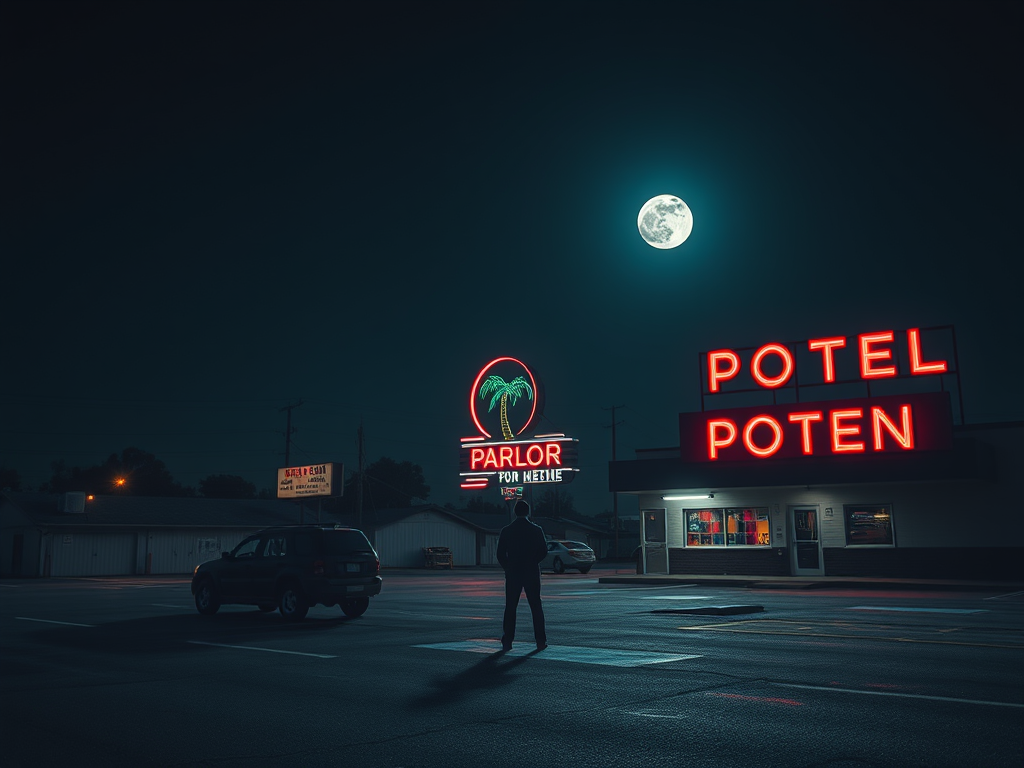
The ivory light of the moon spills through the bars in front of the neon sign.
Lost in memory, I press too hard, the needle punctures the skin, and a single bead of ink rises from my flesh. It blooms and breaks, cutting across my palm, trickling up to my middle finger.
The Fate line.
I draw her reading needle through the blood and study it.
As a boy, the Fate line seemed most important, the grand finale of every reading. Watching my mother perform, it was apparent that even when seekers came to learn of their fortune or health, what they longed for was the truth within that line. She would always pause before that reading, the tip of her cigarette illuminating her eyes while all else was shrouded in smoke.
“This is where I deliver the truth,” she would tell me later, “the one we all want to hear. Our Destiny.”
It was bullshit, a reading based mostly on the look on their face, the condition of their hands, and the questions they asked. It was the lie that was the worst… the one that I gave a piece of myself to every client for as a penance. Your line is deep and true? You will find success with your career and desires throughout life. Your line is deep but fades? You must concentrate on your success while you’re young, for your luck will soon run out. Your line is thin and shallow? You will not achieve your goals. Put your energy elsewhere.
Or… you are not bound to your current destiny.
There is another pinch, and a second tear rolls across my palm, cutting from between my index and middle finger to the outer digit of my left hand. The Heart line. Before I can stop myself, the needle pierces the Venus Mount, the fleshy mound beneath my thumb that my mother taught me to use when testing steak tenderness when the palm wasn’t being used for divine purpose. Point after point the needle penetrates flesh, harvesting blood and carving lines that sweep across the pale canvas of my hand.
And I can see it, but I cannot read it.
The moon draws me from the table, and I stumble out into her light. It is cool and soothes the stinging in my left hand. I thrust my hand out in front of me and open my palm. My mother’s needle rolls from my fingers, spinning in the air like a broken compass before shattering on the ground among the half smoked cigarette butts of the strip mall parking lot. Blood webs across my hand in sticky red threads, dripping from the sides of my palm. The Head bleeds into the Heart. Fate into Health. I trace my lines with my finger and read them for the first time. I read my destiny. And although I am terrified by my reading it, like the moon above, the act fills me with something I haven’t felt since my mother proclaimed me to be the last great palmist.
Nastya Ivanov stared at her reflection in the mirror. The black tile in the background contrasted the golden aura emanating from the globe lights above the sink, casting her pale face in a corona of warmth. Gray eyes peered at her through heavily mascaraed lashes, scrutinizing her appearance as she practiced some of her mannerisms. She applied another layer of lipstick and stepped back. Her silver dress shimmered in the dimly lit room, reflecting dots of light like the scales of a fish. It was something that Sarah Artinian wouldn’t have worn, but it suited her just fine.
The momentary thought of that name caused the corner of her mouth to twitch. She clenched her jaw and closed her eyes.
Я – это я she repeated to herself, finding the sounds in the back of her throat instead of her nose. She forced the image of the woman that she was to the surface, drowning any hint of the woman that came before her. She straightened her spine until she was practically leaning back. Eventually the voice that came from her mouth flattened into its Russian accent and cadence. When she was certain she would open her eyes and see herself, she did.
Standing before her was a dead woman.
The past five months had changed Nastya Ivanov. It had faded her brown hair to a straw blonde, and her eyes had lost their vibrant green in favor of a pale gray. Her breasts had gone down by a size, while her ass had gained as much. Her feet hadn’t needed to change sizes, which was good. To do so would have required too much time for recovery. There was no room for error, not with this disguise. Nastya was an influential celebrity and would be recognized by almost anyone in the nation. Now, all that remained was the memory of a tiny brown dog, a photograph of a brick Victorian house in Boston, a microchip embedded in between the joints of her right big toe, the mission, a key to a car in a parking garage five blocks away, and a plane ticket in the glove box.
Tonight was Nastya’s last night on Earth.
***
When she reentered the dining room, the conversation had lifted considerably. The food had been removed. A shot of vodka sat perched on a red napkin. Approaching, she watched as the eyes of the gentlemen seated around the table turned towards her, aware of the yoyo action that so many men think women oblivious to. Sergei Sokolov, Russian diplomat, ex-KGB, her lover, ogled her hungrily and offered her his stubbled cheek, which she kissed. She rounded the head of the table, to the chair on his left. A pair of gloved hands swept around her and pulled the chair away from the white slab of marble Sergei lovingly referred to as his torture table.
“Here, I can obtain whatever I desire. Power. Information. Women,” he’d told her once, drunk on Sbiten, hands fumbling for the buttons of her silk blouse. Nastya took him upstairs, and there used another piece of furniture for a similar deed. Men were susceptible to sharing secrets when their pants were removed. It was in these moments post-coiatus that she’d learned the names of double agents within the U.S. intelligence network, dates of potential mortar strikes, even petty blackmail. But tonight was to be her biggest score.
That was the date, time, and method of the assassination of a western diplomat.
Nastya took a seat. Sergei stood, raising his shot glass. The others at the table did the same. Nastya took it in her left hand, despite the predisposition of the woman she’d been before.
“To terrible deeds,” he spoke in Russian, “and the good they bring to this world.”
“за нас!” To us! came the response.
Nastya had met herself only once in a past life, at a red carpet event that her former agency had sent her to. The women had talked briefly. In that time Nastya observed some of the miniscule ticks the model had had that weren’t prevalent in her Tik-Tok videos and interviews: the way she pursed her lips after words ending in a “r” sound, her habit of biting her thumb when she was nervous.
“We are through talking business, yes?” grumbled Dima Petrov, waving his sausage-like fingers. This was the transition Nastya had heard Sergei discussing on their way back from dinner two nights previously, the phrase that dictated that the night was shifting from banter into one of action and decision making.
“Politics are exhausting. Every solution is the beginning to another problem,” agreed Abrasha Belov, an oil baron who Natsya had met only once, but whose temper and cocaine use were notorious.
“Let us begin with a celebration then,” Sergei snapped his fingers and a man with a bottle on a silver platter appeared. He poured himself another shot of vodka, and then took Nastya’s glass and filled it.
The bottle traveled around the room, each man pouring himself a full shot. The liquid dispersed, Sergei raised a toast.
“To my beautiful daughter, Elizaveta, and her upcoming birthday!”
Glasses crested and fell in the dim light. The vodka was smooth and clean. As she swallowed, Nastya flipped through briefings in her mind. The diplomat did have a daughter from a previous marriage. She was a bit younger than Nastya, who had been 24 when she died.
“Your daughter is becoming a woman this December if I’m not mistaken,” Dima recalled, massaging his jowled chin. Natsya noted the young woman’s age as 18. And so, she thought, we have a date.
“She is. I will not be able to fight off these young men for much longer.”
“Perhaps it will not be the young men you must watch out for, is that not true Nastya?” a gentleman named Lenya who Natsya had not met until this night spoke. She didn’t like the way he studied her. Sergei stiffened in his seat.
“Well if young men took my Sergei for example and used their mouths for more than just talking, I would have more interest in them,” she replied. Sergei’s hand found her knee and gently moved the slit of her dress so he could caress her bare flesh.
“Your accent is curious,” Lenya stated. “Where did you say you were from?”
“Kologriv,” she stated without thinking.
Lenya looked at her suspiciously. “You speak like a woman I knew from Tambov. I am fascinated why you speak like a southern girl.”
Nastya was aware that the focus of the room had shifted from her lover to her. Kicking herself, she made a quick correction to implement Оканье to her vowel structure. “I have been to many places here and abroad. Forgive me if my tongue sometimes… slips.” She reached down and slid Sergei’s hand further up her leg in an attempt to draw his attention elsewhere. “Where do you plan to take her to celebrate, my love?”
“I hear bird watching is quite pleasant this time of year,” spoke Dima. “Perhaps a trip to the country. Robins in the snow have always been a striking image.”
Sergei was silent.
“I disagree. I always find myself searching the skies for a golden eagle, something more majestic to instill within myself a feeling of power,” suggested Abrasha.
Again, Sergei said nothing. Nastya made a note of these two birds, and their national origin.
“My Elizaveta is a strong girl, not prone to stillness or idle time. She desires to make with her own hands. No, a turkey is what she wants to hunt and prepare for her feast.”
The room was silent. Sergei’s eyes shifted to each of the gentlemen, their faces cast into shadows by the low light.
So… the target is American. Nastya thought to herself.
“Sir, I agree that turkey is a fine beast, but is it in season?”
“It is the right season.” Sergei Sokolov’s voice shifted, losing its bright and boisterous timbre. It was a tone she’d never had directed at herself, for she was compliant to his wishes and he was a gentleman towards her. But during late night phone calls, before the disappearances of revolutionaries, yes, she had heard it.
“Which turkey, my friend?” asked Dima slowly, his hands moving only to take the bottle of vodka from the center of the table so that he could pour another shot. Again, the bottle orbited the table. When it reached Nastya she looked to the diplomat next to her. Sergei nodded and she filled both their glasses. Nastya was known for her late night Instagram posts in which she outdrank celebrities and artists, but as she tipped the glass back she worried about the fog that was building in the back of her mind.
“The biggest one she can find,” Sergei dismissed this comment with a wave of his hand. There was an uncertainty settling within the men around her, Nastya noted.
Abrasha was the first to speak. He sniffed and slapped his hands together. The men perked up, as if drawn from an impending slumber.
“Wonderful, and is this for lunch, or dinner?”
“Dinner, I think,” Sergei replied. “She wishes to prepare it, but it is the dessert I want to be a gift.”
Nastya’s mind raced. Was this part of the code or a deflection?
“Cake perhaps?” shrugged Kolya.
The man named Lenya shook his head. “A cake is not dense enough for a girl with such… refined taste. Perhaps a truffle?”
“It should be rich enough for her, yes,” Sergei agreed. He placed a hand on his stomach. “But as you know, such decadent treats make me sick.”
She studied the large man on her right. Everything he said had to mean something. Every gesture, every word was meant to be vague but pointed enough for the orders to be carried out. Glancing at the others at the table, she saw them nodding along. The words were muddled in translation, but she tried to work through them.
“But I am afraid the woman who is my chef, she is not strong with these sorts of things. Her pastries, divine, but her sweets leave much to be desired. One of you perhaps?”
Dima Petrov looked particularly discomforted. His fat fingers rolled around each other like hot dogs at a United States gas station, something Nastya couldn’t believe she longed to see. Abrasha opened his mouth but hesitated.
It was Lenya who rose from his chair. “My cousin is a chef, studying in France. He is good at his trade but his wallet does not agree with his…” he paused. His eyes turned to Nastya, “lavish lifestyle. I believe an opportunity to prove his skill might earn him a seat in this house.”
Sergei’s head bobbed up and down.“I do agree, friend. If he can be convinced to make this dessert for my daughter, and it satisfies her, he would find a space in my kitchen.”
Lenya finished the rest of his shot, and strode to the head of the table. He took Sergei’s hand and turned to the woman on his left. “It is an honor to finally meet you, Lady Ivanov. I have spent hours admiring you. To see you in person…Forgive me, you have a different appearance.” His eyes darted from one to the other. “More beautiful than I remember.”
He released the politician’s hand, bid the rest of the room “Доброй ночи,” and disappeared into the gloom. The others turned from the departing man back to the table and Nastya became acutely aware of three things.
The man named Lenya knew she was not Nastya Ivanov
She had two minutes before he would be calling a gray cellphone in the top right drawer of Sergei’s desk
Sergei Ivanov planned to have the President of the United States assassinated on December 18th by poisoning him after dinner.
The bottle floated around the table a second time and this time it was Abrasha Belov who rose from his chair. “A toast to your daughter’s birthday. We wish her a successful hunt, a marvelous dinner, and the richest life in the years to come. За успех!”
The bottle reached her. She put up a hand and passed it to her lover. When Sergei caught her eye she closed her lids slightly, swayed in her seat, and shook her hand, a trace of mimicked lust on her lips. He winked at her.
“За успех!” The words echoed around the table. The deed was sealed. Nastya rose and kissed Sergei.
“Ложитесь спать,” Come to bed she whispered the same way she had in many perfume commercials. Turning, she walked towards the hallway. She hoped the sound of her footsteps masked the thundering of her heart in her chest. The corridor was miles long, the richness of the red carpet and mahogany wood creating a coffin-like sensation as she approached the rooms at the end. There, she turned left into the politician’s office instead of right, to the bedroom.
The door had not even closed when a soft hum vibrated through the gloom of the office. The desk was illuminated only by the harvest moon yellow of the streetlamp outside. She crept towards it and, removing one of the bobby pins in her hair, fumbled with the lock of the drawer. It was open within seconds. She picked up the phone. Somewhere down the hall, Russian laughter rolled thick and lush, and she nearly dropped the device. There was one missed call, a name she’d never heard or seen.
Taking the phone to buy more time, she pried the window open. The air was sharp and biting. It cut through the material of her dress. She pulled off the silver gown and flipped it inside out. It became something new. Within the material were buttons to give the impression of an overcoat, and fabric that had been tucked down the back elongated into sleeves. She pulled it back over her head and slunk out the window, pulling it closed. Her movements were quick, but controlled. The pins fell from her hair and loose curls tumbled down her shoulders. A napkin removed the bright red shade from her lips. Tonight, Sergei would begin the search for her. A month later a body would be dumped from an unmarked van into the Yenesei river. A badly decomposed, water logged Nastya Ivanov would appear. There would be no signs of foul play, just the lingering traces of heavy narcotics use that had, unfortunately, led to her actual demise. Sometime, a month later, an assassination attempt on the President would be thwarted. No one but Sergei and his men would know.
And somewhere in Boston, a woman named Sarah Artinian would be drinking chai tea with a book in her hand and a small dog on her lap.
That is, if Nastya could make it to the airport before word of her disappearance caught her.
When the boy stepped into the cockpit, all was silent. The flashing blues and yellows of the dashboard had ceased. All that remained, present through the window that encompassed them in a half-sphere, was the infinite abyss and the few remaining stars that flickered within it like distant lanterns. He took a step, and from the gloom a flat, staggering voice spoke.
<I apologize. I believe that I have failed you.>
The boy approached the twin chairs at the front of the room.
The robot sat rigid in the leftmost chair. Rivulets of oil leaked from its visual and auditory receptors and loose panels clung to wires like the last of Autumn’s leaves on her branches. At the sound of the boy moving, the robot turned its head to perceive him.
“But you said we only have a month left. We’re so close,” the boy whispered.
<Correct. Software has begun to fail, Casius. My system is deleting memory files to prioritize essential functions. Once those are erased, the operations bank will shortly follow.>
The boy lowered his head, strands of long, brown hair shrouding his face, and sniffled.
“It’s my fault, isn’t it.”
<To put you at fault would be to insinuate that you were in control of this situation. The prolonged exposure to the radiation levels your heart emits has caused the failure of my system.>
Silence invaded the spaces where the robot had once played ancient 00’s dance hits from its internal speaker.
“Can’t you rebuild yourself?”
<I have done so many times Casius, but we are no longer in possession of the necessary parts. And this time, I am afraid, it is not my hardware.>
“But if we change course, surely we can get to Zalaria-1 or Uxx-”
<Your mother’s final directive was very clear, child, as were the lessons she wished for you to learn. Lesson one->
“Do not blindly trust,” the boy spoke reverently.
<Precisely. To put our fates in someone else’s hands now, when we are so close to our objective, could place you in a vulnerable situation. To do so would be a waste of your mother’s death.> The robot lifted its right hand. Its internal mechanisms groaned, and it trembled as it fought against the violent radiation damage done to its form. A rusted finger found the boy’s cheek, where it collected a single teardrop. <Don’t cry child. You will need the moisture.>
“Tell me about her again.”
<The many traits you seek to know about your mother are within you Casius. Your intelligence, your compassion, your knack for tinkering. All of these are traits she possessed.>
“And my father?”
<As I do not possess a picture, you will simply have to look in a mirror. There, you will find his face.> The robot paused, processing its responses where they had once been instantaneous. <and his bravery.>
“What did he do that was brave?”
<You are aware of this story, but I will recount it for your comfort. As he and your mother were being hunted for your species’ Gaianium hearts, your father was one of the last to stay on Toros while your mother and I escaped. All transmissions from Toros, post-vacancy, were coded with imperial encryption. Completion of your father’s mission had minimal success probability, and yet he stayed to delay Imperial troops.>
The boy turned from the robot and stared out the front of the craft. The android noted the boy’s posture straightening, but did not acknowledge it.
“And you think I’m that brave?”
<Yes. And you will need to be.>
“What if I’m not able to? What if I’m afraid?”
<Fear is unavoidable and, like any emotion, it should be allowed to exist. Do not be unafraid. Be afraid, but be still in your resolve. Lesson Two.>
“Be prepared, and your fear will be manageable.”
<Correct. That is bravery.>
“Are you brave?” the boy asked.
<I am not able to be brave.>
“But you’re not afraid.”
<I am unable to feel fear, Casius.>
“But you’re dying.”
<My system is failing, as are my physical and computing functions.>
“And you said so yourself: it is built into your programming to survive.”
<That is… correct.>
“So you went against your programming to protect me.”
<That is… correct. As your mother died, I held you to my internal core and processed in patterns that would elevate the output temperature of my CPU to match that of her pulse.>
“But… you also knew about my Gaianium heart.”
<I am aware of your species’ condition. Yes.>
Silence fell upon the cabin. All that cued the boy into the android’s continued existence was the sluggish blinking of its singular, crimson retinae. The robot shifted in its seat, its internal mechanisms grinding and thumping.
“What if they’re not out there?” Casius asked. There was a whirring sound.
<There is a 65% percent probability that this is the case. However, the high levels of radiation emitted from the core of Yosan and its proximity to the nearby sun make it a suitable candidate for not only the rumors, but the survival of your species.>
“But what if we arrive… and I’m all alone?” the boy asked. The robot reached out and placed his heavy hand on the boy’s shoulder. Bits of rust crumbled from it as he did, and the boy placed his cheek upon the cold metal.
<Inform me of your survival plan… Casius. Files containing it are in queue to be deleted.>
The boy took a deep breath and rose from his chair. There was an orange stain on his cheek from the robot’s hand.
“Step One: Early rituals. 50 push-ups. 50 sit-ups. 50 lunges. Eat nutrition bar. Clean body. Maintenance check on body.”
<…Correct…>
“Step Two: Maintenance check on ship. Ensure no unnecessary power is being wasted.”
<…Correct…>
“Step Three: Assess course. Adjust auto-pilot if needed.”
<…Corr…ect…> The robot’s form groaned as it slumped over in its chair.
“Step Four,” the boy’s voice hitched. “Record findings, discoveries, and thoughts in log.”
<…Corr…ect…>
“Step Five: Late rituals. 25 push-ups. 25 sit-ups. 25 lunges. Eat nutrition bar. Clean Body. Maintenance check…”
The boy stopped reciting his programming. The soft red light of the robot’s retinae had gone out.
<Continue…Casius… I am still cognizant.>
“When will you forget my name?”
<It will be the last thing I delete. Your final directive… please.>
“Step Six: Story time. Stargazing. Rest.”
<Ha. Ha. Ha.> The boy jolted, having never heard that sound before. < I am… laughing… to show that I approve… of your memory. You will not fail yourself.>
The boy reached out and placed his hand on the robot’s, aware that the nerve receptors built into its hands would no longer be able to feel his.
“Would you have lived forever…to see the stars go out?” Casius asked, his eyes on the slumped shadow. A minute passed. Terror and loneliness welled up inside the boy until the voice spoke.
<Would my fuel… cells and hardware… components have allowed it… yes…… But… there is… more beauty… in the life of something… than there is in the death of it……..>
“The third lesson,” the boy spoke in a hushed tone.
<…Casius…>
And then there was the Silence, the oppressive emptiness that fills the room after the final exhale. The boy removed his hand from the unmoving fingers of the communications robot, and climbed up in its lap just as he had done when he was smaller. Together, one seeing, the other not perceiving, they stared out into the great nothingness. He allowed himself to mourn. He told stories of boys exploring planets containing dangers and plants he’d only read about. He shared customs and traditions passed down from his mother to this robot, to himself. He identified distant constellations and told stories of a robot who, abandoning post and directive, took a dying mother’s child and sustained its life. And when the time came, he rose from the husk of his guardian, collected his tools, and undid the android’s lower extremities for he was not yet strong enough to carry its whole form. After his work was finished, he took the upper half in his arms and, like it had done for him so many times, carried it to the bed adjacent to his. He pulled the sheet over its head, recited the three lessons, and closed the door.
When he returned to the cockpit it was darker still, the quiet more daunting, the great expanse of space infinitely intimidating. The boy strode back to the robot’s chair and took a seat in it, inhaling the musk of motor oil and fried circuits. He stared out into the abyss, and even though he was frightened and alone, he remembered the final rule, the one given to him not by his mother or father, but the robot who had cared for him the first decade of his life. He spoke it aloud as his ship floated through the darkness, towards a life and hope uncertain.
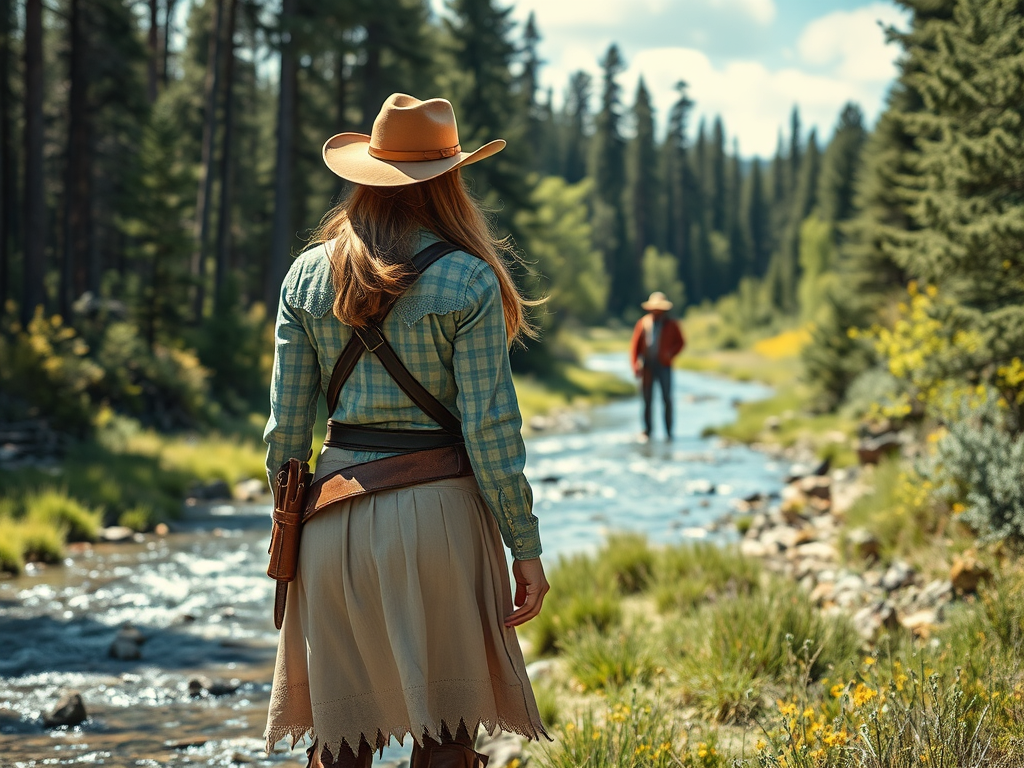
The shadows were short when Saratoga Jane heard a commotion rise up from the main street of Amber Creek. It was interposed by shouts sharp enough to punctuate the thick stench of hot piss that permeated Jane’s tannery on the outskirts of town. A commotion wasn’t uncommon around this time of day, but she’d worked all morning and nothing made her happier than to witness someone receive an ass whoopin’. Wiping the fat and residual animal hair from her hands, she left the shade of her workshop and turned towards Amber Creek.
A crowd stood outside the Red Lady Saloon. Rising entangled from the din was a man and woman’s voice This wasn’t uncommon either, as men were oft on edge when their peckers were stiff, as were women when men’s stiff peckers were unwantedly close to them. Still, she placed her fingertips on the Sharps rifle she kept tucked next to the threshold, spat a wad of dip into the dust, and waited to see what would arise.
No sooner had the noise dwindled when there was the crack of batwing doors bursting open. Folks scattered like grouse from a meadow. The cloud from their exodus swirled like a dust devil, and as it thinned the figure of a man in a pale leather jacket and black hat remained standing in the middle of the road. To his right, another figure knelt in the dirt. In his left arm was a parcel.
Jane stepped into her tannery and donned a vest she’d made for herself last winter after the shootout with the Poudre Valley Bandits. She’d stitched four thick layers of buffalo hide to the front and back, a design that had not proved itself to be bulletproof but had seemed to allow less penetration when she’d strapped it to a cottonwood and unloaded her Peacemaker into it. She pressed a bullet into the rifle’s breech and made her way towards town.
The silence was the kind before the drop of a man at the gallows, a collective holding of breath drawn in even by the structures lining the streets. Jane had made herself familiar with this silence over the years as Amber Creek’s unofficial sheriff, as it was the same one that gathered in between the counts of paces in a duel. She marked her breathing, minded her surroundings, and relaxed her muscles. To be stiff was to preemptively lay in one’s grave.
Thirty paces from the man, she stopped, and called out
“Contrary to what your Papa might have taught you, Tom Mackey, most women don’t like being dragged about.”
The man turned, and Jane could see, even from a distance, that he was in his cups. Capillaries spread from under the shadow of his hat brim like roots from a clod of dirt. He swayed, drawing the woman kneeling next to him closer.
It was Danni Winters.
“I’d call you a law man, but we both know ye ain’t got a gun in yer sheath,” the drunk cawed.
“And I’d ask you to act like a gentleman, but I’m confident I can come to the same conclusion. Let her go.”
Tom Mackey hocked a loogie into the prostitute’s hair. The bundle in his arms squirmed. Jane’s eyes flickered between it, the girl, and the drunk.
“That her kid Mackey?”
“Ain’t got no right to keep ‘im from me. ‘E’s mine too.”
“There ain’t no way for you to know that. God knows she’s had other-”
Jane was known as a quick draw, but the sight of the child made her hesitate. In one fluid movement, Tom Mackey released Danni, and drew his pistol. The first shot found Jane in her shoulder. She dropped. Hitting the dirt, she found a thundering ache in her left arm when she tried to prop herself up. In the same movement, Tom swung the pistol level to Danni. He pulled the trigger twice. Crimson erupted from the prostitute’s bodice.
The tang of gunpowder and the wail of a child was overpowering. Using the rifle as a crutch, Jane struggled to her feet. By the time she’d regained her composure, the coward had taken off, his left arm clutching the child, the pistol in his right scanning the empty boardwalk. Jane brought a hand to where the bullet took her, and found not blood on her fingertips but flakes of sand-colored leather. By the time she’d raised her rifle, Tom had mounted Jim Barnam’s horse, and was gone.
Staggering forward, Jane felt the town around her come to life. When she reached Danni, the prostitute’s powder blue petticoat had been stained to a deep maroon. Jane knelt and took Danni in her arms, stroking strands of hair off her sweat soaked face.
“At least it’s finally cold here,” Danni Winters gurgled. A hand reached and found Jane’s. It was soft and clammy. “Bring ‘im…”
The girl’s voice was seized by a hitch, and when her final breath floated from her throat it brought with it a trail of blood. Jane had been Death’s accomplice from the moment she’d split her mother open. A life soaked in blood and brined by mountain air had left her thick skinned and tough to chew. It was enough to tan anyone’s hide.
But the child…
A muffled thump of boots in the sand approached. Jane looked up into the shadow of a boy. Manicured fingernails swept over an upper lip with four thin hairs. A shiny government star glared on his chest. Sheriff Giles cleared his throat.
“Shame to see what a girl’s lifestyle will bring upon her.”
Jane lay the girl’s head down, rose, and started off west.
“Carry her body to the cold shed and tell Doc to prepare it for viewing. I’ll be back before sundown.”
Spurs clacked as the boy scampered after her.
“As appointed sheriff-”
“Week’s been hot. A body’ll smell soon. Tell ‘im we’ll bury her at dusk.”
“I’m not a messenger boy, I’m the Law!”
“Town had Law before Uncle Sam slapped a star on a baby and sent him to play cowboy.”
“Now just-”
Jane spun and took a fistfull of his collar. The boy cowered, repressing a gag as he inhaled her stench. The life of a tanner was a lonely one. Jane preferred it.
“Go home and grease your gun, kid. Your help is unwanted.”
She sauntered off to the stable where her horse was kept. Already saddled, she swung herself upon Folstam and, with a slap on his backside, sent them galloping towards the looming wilderness.
***
Two hours later, Jane knew she’d regained some ground in her pursuit. What few horse tracks she found in the mud had grown shorter and more abundant. Tom Mackey had slowed, at least along the creek. The tracks made their way into the water. Either he was trying to throw her off and was on the other side, or he was traversing up the creek. The ride through the mountains had been hard. Folstam was foaming at the mouth. She dismounted and led him to one of the smaller offshoots of the main water. As he drank, she crept to the other bank and, finding no tracks, decided that Mackey had continued his trek up through the stream. They trudged on, keeping to the bank where the shadows were the most prevalent and where the sound of their footfalls would be masked by the gurgling stream.
Amber Creek was five meters wide and, at this time of the year, had reduced to a gentle crawl. Cottonwoods sparsely lined the sides of it, their gnarled bark burned white. Low water rolled over rocks, turning them into balls of glass. Jane continued until she heard a sound in front of her: a low, haunting wail. Wrapping Folstam’s lead to a tree, she crept forward alone.
Tom Mackey waded in the shimmering creek. Head low, horse lead in hand, he struggled knee-deep upstream. He still held the baby across his chest. Jane placed a pellet in the primer.
The child complicated things. If she took Mackey in the back, there was no guarantee that the bullet wouldn’t pass through and hit the child. If she shot him in the head or leg, there wasn’t a guarantee that he wouldn’t fall on the baby or drop it in the river. Either she would have to reposition in front of him so she could see the child, or she would have to draw him to her by calling out.
A third option presented itself. A loud crash tore the air. Jane turned, and found that Sheriff Giles had led his horse at a gallop into the waters twenty paces in front of her. Pistol drawn in an act of excess machismo, and the young man fired a shot into the sky.
“Scoundrel! Surrender yourself to the Law!”
Tom Mackey was drunk, not stupid. Releasing the reins, he twisted and unsheathed his pistol. There was a wet, thud, like a hammer hitting soft clay. Giles’ horse’s head jerked and, taken by Death, sent them both tumbling into the water. A shot cracked from the sheriff’s revolver, and snapped off into the foliage. Giles leapt from the falling beast and crashed into the mountain stream.
Tom Mackey faced his adversary. Babe clutched to chest, he fired again. The water in front of the flailing sheriff spouted. Slipping to find footing, Giles sent another two shots the drunkard’s way, oblivious to the kid. Jane noted he had one shot left before he needed to reload. Mackey had three, assuming he reloaded after shooting Danni. The boy scrambled across the stream to use the animal’s corpse as a barricade. Jane lay her rifle in the crook of a tree and reassessed.
While the boy shouted ordinances, Jane worked through her shot. If she took Mackey in the head, there was a chance his neck would snap backward, but he would fall forward. If he did, he would either crush the child on the river rocks or drown it underneath him. The right shot was the neck or upper chest. If the bullet found him there, it would carry his body backwards, the child landing upon him, hopefully giving her time to retrieve it.
Another gunshot. The boy had rechambered and was shooting wildly at Mackey. Jane nearly screamed at him to cease, but couldn’t’ afford to draw any attention. A bullet took Mackey in the leg and he collapsed to a knee. The boy rose and fired once more. A fountain erupted to Mackey’s left. The child squirmed. Mackey leveled his iron.
The bullet took the expendable Sheriff Giles in the head. He staggered a pace to his right before dropping. Letting out a yell, Mackey straightened his right leg, and started to rise. The babe thrashed in his arms, and he lowered his pistol to regain his grip on it. The child’s head bobbed up to the level of Mackey’s throat.
Jane exhaled and fired.
A mist of blood exploded from Tom Mackey and he, like the husk of a burnt cabin, collapsed backwards.
The child stopped screaming.
Jane was up before Mackey’s body hit the water, and was thrashing towards him through the river as, on his back, he floated towards her. When the body was a stride away she plunged upon it and took the babe into her arms. It was covered in thick, warm blood and was still. A lump in her throat, she turned the baby to look at it.
Danni’s child stared up at her with open eyes, reaching toward her leathered face with its soft, delicate hand. Collapsing to the rocks of the river, aware of the dull pain that shot up her knees when she did, Jane held the child and wept while her rifle smoked on the bank and two corpses floated past her, down river, towards the town that was its namesake.
Genre: Action/Adventure Event: Superfluous Character: A Tanner


 The Word and The Song